MESSAGES THAT LAND – Monday 24th August
Approved by everyone. Understood by no one. Here’s how we fix that!
I used to write advertising copy for a well-known UK pharmacy chain.
Then one day, word came down from HQ:
“Please make our adverts more creative and entertaining. We want to capture the attention and imagination of the people walking into the pharmacy.”
Music to our ears.
They had a new person at HQ and she understood something important: complying with the rules didn’t mean the work had to sound like it had been written by a committee.
So my team and I got stuck in.
We brainstormed campaigns, developed themes and spent proper time crafting ideas that spoke to the person standing in the pharmacy rather than writing in Pharmacy Speak.
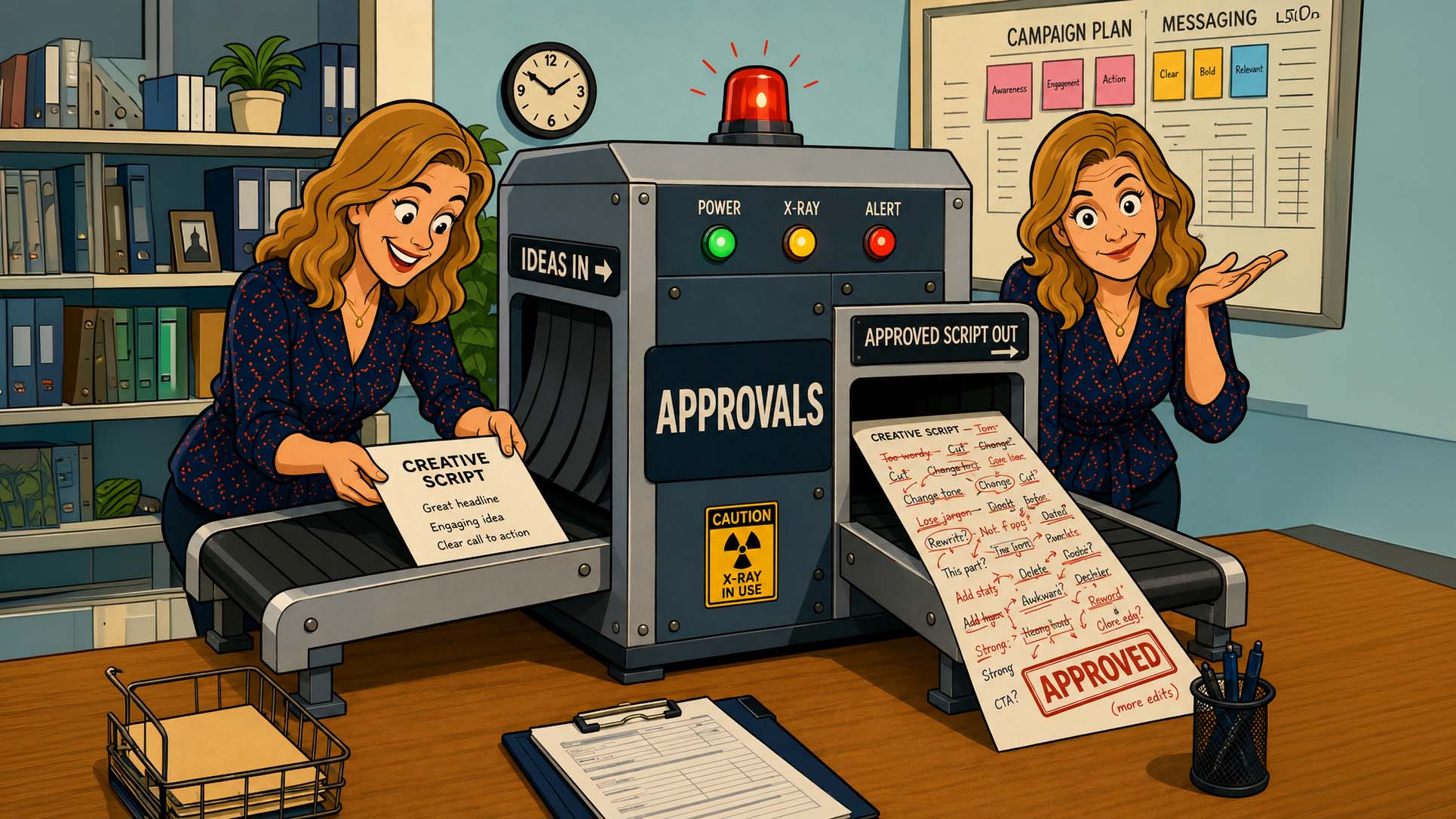
The scripts went off for approval.
Then they came back.
And most of the interesting bits had disappeared.
Some of them now read more like legal documents than advertising.
So what went wrong?
Nobody involved was stupid.
Nobody had deliberately ignored the brief.
And everyone broadly agreed that the work needed to be more engaging.
The problem was that the job changed as the script moved around the organisation.
We were asking:
“Will somebody notice this?”
“Will they understand it?”
“Will they care?”
The next person might quite reasonably have been asking:
“Could this be misunderstood?”
“Can we substantiate this?”
“Could somebody complain?”
“Am I comfortable putting my name against this?”
That’s human.
We tend to feel the potential pain of something going wrong more strongly than the potential benefit of something going brilliantly.
Psychologists call it loss aversion.
And when people are working in different departments, often at different times and increasingly from different places, they don’t necessarily have the conversation that accompanied the original idea.
They just receive the document.
So the safest-looking words gradually win.
A phrase gets made a little more precise.
Another gets replaced with something more familiar internally.
Something playful disappears because nobody quite knows whether it is essential.
And eventually everyone has done their job perfectly…
…but the person walking into the pharmacy hasn’t got a clue what we’re trying to say.
So rather than trying to redesign the entire approvals process, there’s a much simpler thing you can do.
Put the intention at the top of the script.
Before the actual copy, add something like:
WHO THIS IS FOR
People walking into the pharmacy who may know very little about this subject.
THE ONE THING THEY NEED TO UNDERSTAND[Write it in one sentence.]
WHAT WE WANT THEM TO DO / THINK NEXT[One intended response.]
WHY IT IS WRITTEN THIS WAY
The conversational language and opening are deliberate. Their job is to attract attention and make the message understandable to someone without specialist knowledge.
WHEN REVIEWING
Please flag anything inaccurate, misleading, non-compliant or genuinely risky.
If wording needs changing, please try to preserve the intended meaning and conversational tone rather than replacing it with internal or technical language.
That’s it.
You’re not telling Legal how to do their job.
You’re giving the next person in the chain a piece of context they would otherwise never have received.
And once the approved version comes back, do one final thing.
The Repeat-Back Test
- Find someone who wasn’t involved.
Not the marketing team. Not the product expert. Not somebody who sat through the briefing.
- Show them the final, approved version.
Then take it away and ask:
“What do you think we were trying to tell you?”
Not:
“Did you understand it?”
Most people will politely say yes.
Ask them to tell you what they think it meant.
- Listen to what comes back.
If they can explain the central idea simply, great.
If three people tell you three different things, resist the temptation to add another paragraph.
Go back to:
What is the ONE thing we actually need them to understand?
Then make that clearer.
Because the real test of a message isn’t whether Marketing likes it.
Or Legal approves it.
Or six intelligent people have signed their names against it.
It’s whether the person outside the room can tell you what you meant.
Your message isn’t clear until they can repeat it back.