MESSAGES THAT LAND – Monday 23rd November
When expertise get’s in the way of the message.
No it isn’t dumbing down!
There is a particular moment that comes up again and again when you are working with people who know a lot about something.
You are trying to make an idea clearer. You take a long explanation and shorten it. You replace a technical phrase with ordinary language. You remove three caveats from the opening sentence and move them somewhere more useful. And somebody says:
“But aren’t we dumbing it down?”
Over the years, I have worked across medical, academia, emerging technology environments and projects involving ideas that were still being tested and developed. The subjects have been very different, but the communication problem has often been remarkably similar. The people closest to the information care deeply about getting it right.
Quite rightly.
Sometimes the detail matters because it is scientifically important. Sometimes because it is commercially sensitive. Sometimes because there are regulatory boundaries that cannot be crossed. Sometimes because the expert has spent twenty years understanding all the reasons why the simple answer is not quite as simple as it first appears. So when somebody comes along and starts removing words, shortening sentences and asking awkward questions like, “Does the audience actually need to know that?”, it can feel uncomfortable. It can even feel irresponsible. But there is a distinction we need to make. Being complete is not the same as being understood. And the purpose of communication is, ultimately, to communicate.
That sounds almost too obvious to say, but it is a surprisingly useful place to begin because it creates a point of agreement. If you are a scientist, an academic, a lawyer, a founder, a technical specialist or a communications professional, we can probably agree on this much: whatever we are saying, we would quite like the person receiving it to understand it.
That is the job.
The job is not to prove how much information we possess. It is not to transfer the contents of an expert’s head, wholesale, into somebody else’s. It is to decide what matters to this particular person, at this particular moment, and then give that idea the best possible chance of landing. That is very different.
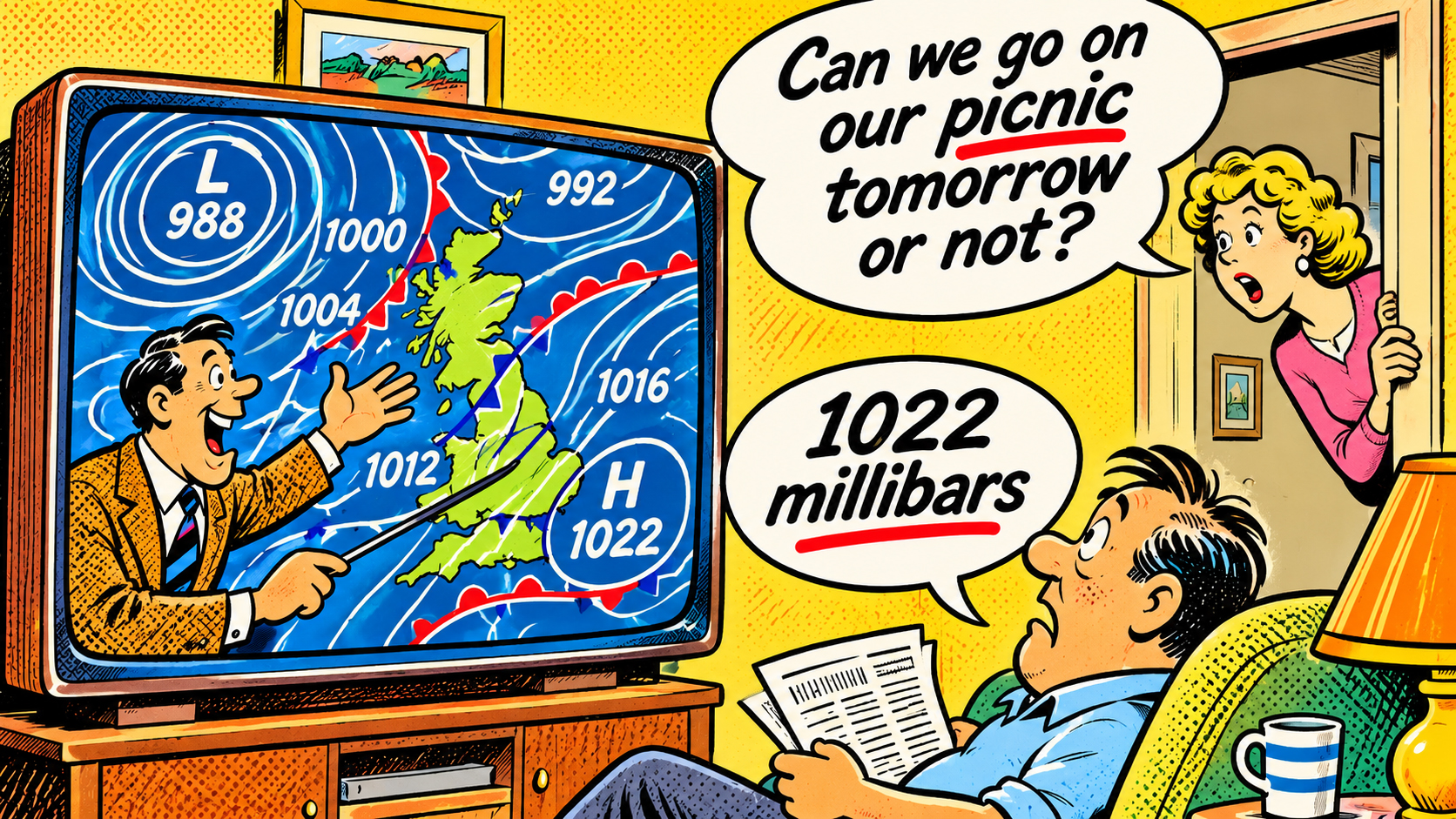
Think about a weather forecast. A television or radio forecast might last two or three minutes. During that time you might hear about pressure systems, fronts, wind direction, rainfall, regional variation and tomorrow afternoon’s temperature. How much of that do you actually remember? Usually, you are looking for something much more straightforward. Will it rain? Will it be windy? Do I need a coat? If you are heading out to sea, the stakes are obviously higher. You may need considerably more detail. You may need wind speed, visibility, sea state and precise timings. But even then, the underlying questions are still very human. Is it safe? What should I do? The meteorologist may understand an enormous amount more than the audience. That is precisely why the meteorologist can make the information useful. The expertise is not demonstrated by telling us everything. The expertise is demonstrated by knowing what matters.
And that is where “dumbing down” becomes such an unhelpful phrase. Because clarity is not the same as simplification for its own sake. Making something accessible does not mean stripping out the intelligence. It’s removing unnecessary obstacles between the idea and the person who needs to understand it. That can be much harder than adding more information.
In fact, one of the great ironies of expert communication is that the deeper somebody’s knowledge becomes, the harder it can be for them to remember what it feels like not to know. An expert hears an acronym and immediately expands it. They hear a technical phrase and understand all the assumptions sitting behind it. They move from step one to step four because steps two and three have become instinctive. Their audience does not have those shortcuts. That does not make the audience unintelligent. It simply means they are standing somewhere else. And if we want our message to reach them, we have to meet them there.
No one asks for something to be more complicated.
Nobody finishes reading a piece of communication and thinks, “That was useful, but I wish I’d had to work harder to understand it.” When we are the audience we value clarity.
If we tell people everything, there is a very real danger that they remember nothing. Which is why, particularly in video, presentations, interviews and campaign messaging, one strong message usually has a better chance of landing than six competing ones. That does not mean the subject contains only one idea. It means the communication needs a priority. What is the one thing we most need this person to understand? That question can be surprisingly difficult.
Internally, five different people may each have something they consider essential. The technical team has one priority. The legal team has another. Marketing has another. The managing director wants a fourth message included because it is commercially important. And suddenly the audience is expected to remember all of them.
They won’t.
The answer is not to pretend the other information does not exist. The answer is to structure it. Give the audience the first thing first. Let the supporting information support it. Then, if they need more detail, give them a route to it. Clarity is not the destruction of nuance. It is the organisation of nuance.
For me, the practical way into this starts with three conversations.
First, agree what the communication is actually there to do. What should the audience understand, feel, decide or do afterwards? Before we argue about phrases, terminology or the length of the script, we need agreement on the job.
Second, decide what they most need to remember. Not everything we know. Not every point that somebody internally would like included. The one idea that matters most to this audience.
Third, translate that idea into human and conversational language.
Say it aloud.
Would somebody outside the organisation understand it? Would someone without the same qualifications understand what matters? Have we kept the meaning while removing the unnecessary friction? If we have, then we have not dumbed anything down. We have made it accessible. And there is an important difference.
Because clarity is not what happens when you take the clever bits out. It is what happens when you understand the clever bits well enough to explain them properly.
So perhaps the better question is not:
“Have we simplified this too much?”
Perhaps it is:
“Have we made it clear enough to land?”