MESSAGES THAT LAND – Monday 16th November
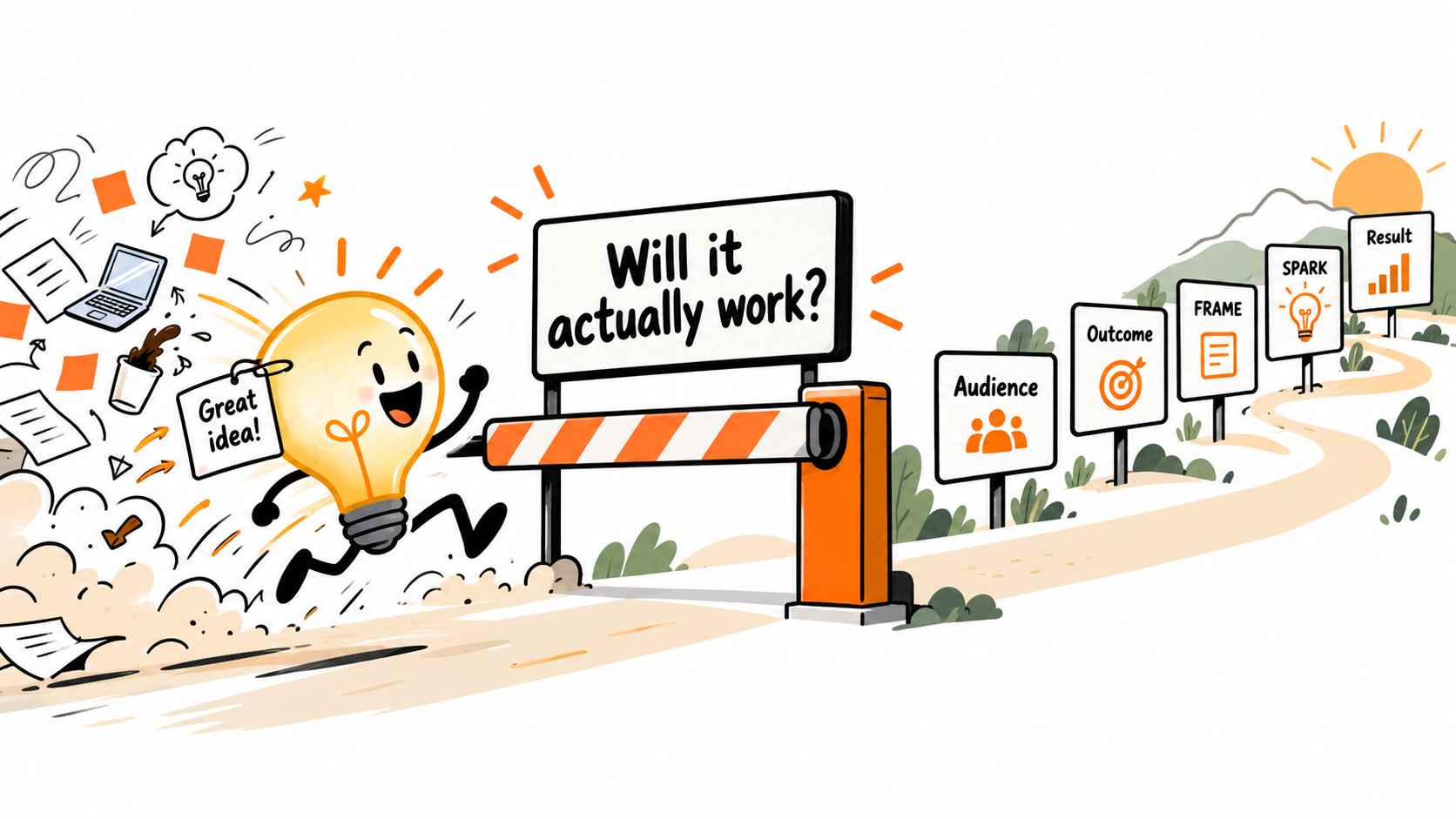
Great idea for a video or podcast. But will it work?
“I’ve got a great idea for a video.”
Or maybe it’s a podcast. Perhaps it is a campaign, a series of interviews, or something that somebody can already picture so clearly that the rest of the room starts getting excited too. Before long, people are talking about who should be in it, where it could be filmed and what it might look like on LinkedIn. There is nothing wrong with that enthusiasm. Good ideas are supposed to create energy. But there is one awkward question worth asking before anybody starts booking cameras or clearing diaries.
How do you know it will work?
That is where a lot of content gets into trouble. The temptation is to start in the middle, with the sexy idea rather than the outcome you actually need. Before you can judge an idea properly, you need to go back to two basic questions: who are we trying to reach, and what does success actually look like? Those two things shape everything else. If the audience needs reassurance, that is a different job from trying to make them remember you. If you need to trigger an enquiry, that is different from trying to change an internal perception. Skip that stage and creative discussions quickly become subjective. One person likes the funny idea. Another wants more detail. Somebody else wants three extra messages squeezed in because “we may as well”. The result can be polished, expensive and completely wrong for the job.
So keep the original idea. It may still be brilliant. Just take a step back to first principles before deciding it is the answer.
That is where FRAME comes in.
First, FRAME the message
FRAME is an acronym we use to check that the message is properly connected to the audience and the outcome before too much time is spent on the execution. It helps create clarity and consistency of message, especially if you are building a campaign, and it gives the creative team a much better problem to solve.
F — Focus the audience
Be specific about who this is really for and what matters in their world.
A software business may want to talk about its clever new technology. But if the audience is an overstretched operations director, the more useful story may be about removing one recurring headache from their working day.
R — Remember the message
Decide the one thing you most want someone to take away.
Five departments may all have something they want included, but if the audience remembers only one thing tomorrow, what should it be? Everything else then has to earn its place.
A — Attention first
Find the reason the audience should care before expecting them to listen.
“We’ve provided professional services for 27 years” may be true, but “Your team is losing six hours every week doing this manually” gives the audience a reason to lean in.
M — Make it believable
Work out what proves the point rather than relying on claims.
“We save businesses time” is easy to say. Showing how a customer reduced a three-day process to three hours gives the claim substance.
E — Expose the objections
Bring the reasons someone might resist, doubt or ignore the message into the story.
If the audience is thinking “That sounds expensive”, “This will be hard to implement” or “Our people will never use it”, those concerns need to influence the message rather than being ignored.
By the time you have FRAMED the message, you know whether the original idea really fits the audience and the outcome. It may survive completely intact, which is great, because now you know why it should work. Or you may discover that the subject is too inward-looking, the opening is wrong, or the bit everyone internally loves is not the bit the audience actually cares about. Either way, that is useful to know before the money is spent.
Once the message is properly framed, the creative possibilities actually get wider rather than narrower. You know what has to remain true, which gives you more freedom to play with how you bring it to life.
That is where SPARK comes in.
Then add SPARK
SPARK is another acronym, but it works differently. FRAME checks that the message is pointed in the right direction. SPARK gives you a set of tools to make it more attention-grabbing, immediate and human.
You do not need to force every element into every story. Use as many as genuinely help.
S — Stakes
Give the subject consequence. What matters if this problem is solved, or if it is not?
“Poor internal communication” is abstract. “Your best people are finding out about major changes through corridor gossip” suddenly feels more important.
P — Present
Give people a reason to care now.
Energy efficiency becomes more immediate when it connects to the bill, deadline, regulation or business decision somebody is facing this month. Horizon scanning — keeping an eye on the news, trade press and what people are already talking about — can help you find the language and timing that connects your story to what is already top-of-mind for your audience.
A — Angle
Look for the unexpected angle.
There is an old journalism line: dog bites man is ordinary. Man bites dog is a story. The same principle applies here. If everybody in your sector is saying the obvious thing, what is the less expected route into the subject that might make someone stop and pay attention?
Instead of another “Five benefits of AI” piece, perhaps the angle is: “What happens when a customer asks AI about your company and it gets the answer wrong?”
R — Relevance
Keep translating the subject into the audience’s world.
Your new manufacturing process may be technically fascinating, but the customer may care because it means the replacement part arrives in two days rather than two weeks.
K — Keep it human
Use real language, experience, tension and stories rather than sanding everything down into corporate copy.
Rather than scripting a CEO to say “Our people are at the heart of our strategic vision”, ask them when they realised something had to change and what happened next.
This is where the creative brief becomes much stronger. Instead of saying, “We need a video, any ideas?”, you can say: this is the audience, this is what matters to them, this is the one thing we need them to remember, this is what they may doubt, and this is what we need the communication to help happen. Now the creative team has something solid to push against.
The answer may still be the original video. But you also have the tools to find a different angle or develop the idea further. When the ideas come back, you have something better than personal preference with which to judge them. The question is no longer simply, “Which one do we like most?” It becomes, “Which one has the best chance of getting the audience from where they are now to where we need them to be?”
That does not make creativity less creative. It gives it direction.
Test it before it goes out
Before committing the full budget, it is worth testing whether the idea actually lands. That can be as simple as showing the headline, concept, rough cut or pilot to a few people who genuinely resemble the audience and asking what they took from it. For bigger campaigns, you might go further with surveys, audience interviews or proper market research.
The level of testing should match the level of risk. The point is simply to get beyond “we all like it” and gather some evidence that the people you want to reach understand it, care about it and respond in the way you hoped.
This approach is about giving creativity a clearer job to do. FRAME gives you the guardrails, SPARK helps you push the idea further, and testing gives you a little evidence before the serious money is spent. You still get to be ambitious, surprising and inventive, but you can sleep a little more soundly knowing the idea has been built around the people you need to reach and the outcome you actually need to achieve.
That is a much better place to start than simply hoping everyone likes the video.
In This Week’s Podcast – Land & Deliver
What if AI is already deciding whether your business gets found?
This week I’m joined by James Armstrong from Social Firefly to look at how AI is changing search, how to avoid the dreaded AI slop, and why your own expertise and judgement still matter more than ever.
Watch or listen at landanddeliver.co.uk