
MESSAGES THAT LAND – Monday 9th November
Is playing it safe becoming the riskiest marketing strategy?
In highly regulated industries, playing it safe can feel like the obvious choice. But once every idea has been softened, approved and de-risked, you can end up saying almost nothing at all. So where is the line between responsible disruption and reckless attention-seeking?
I did something in a creative meeting recently that I hardly ever do: I initially tried to talk the client out of the idea. “Are you sure you want to do this? Could this actually damage your business?” “Surely Darren,” I hear you scream, “this could lose you an important sale. Are you mad?” Not at all. What the client had just said was a joy to my ears creatively, but potentially quite scary for them commercially.
In highly regulated industries, “safe” is often the watchword. Back in the day, I wrote radio commercials for a pharmacy chain and it was one of those experiences you chalk up as a “life lesson exercise”. I would come up with ideas that had a bit of life in them, then they would go through Marketing, senior management and Legal before coming back greyer than a 1980s conference centre carpet. By the end of the process, the risk had usually gone, but so had much of the personality. Not fun.
This particular conversation, though, was about a podcast for a regulated company, so I did what I usually do and started with the questions that matter before anyone gets too excited about format. Who are we talking to? What impact do you want to have? What do you want people to think or do differently? What are you actually trying to change? We got a pretty good picture, and then they said the thing that made me stop.
“We want to be disruptive.”
Now normally, I’m quite comfortable with disruptive. I worked in FM music radio for nearly 20 years, and I’ve worked for companies that brought the Married at First Sight format to this country long before it became a TV staple. At one point we gave away a car to one of five finalists, with the small twist that we crushed all the five cars they currently owned and drove up in, live on air before announcing which finalist had actually won a new one. It was compelling listening. But look, we were playing hit songs to make our money. In regulated industries there are rather bigger things at stake: health, money, people’s livelihoods.
So I pushed them. What exactly did they mean by “disruptive”? Was there a chance of backlash from the regulator? Was this one of those ideas that sounded exciting in a room full of creative people but would feel very different once it escaped into the real world? Their answer changed the whole conversation.
“We believe things have been stuck this way for too long. We want to get the key players on, bring the public into the conversation and have a real discussion that could lead to change.”
And then it struck me: “We believe.” That was the important bit. This wasn’t disruption for the sake of attention or an exercise in making some noise. It was a company on a mission, with a genuine belief that the current way of doing things could be better. Once you know that, the calculation changes completely.
Over the years, especially when working around regulated or high-stakes industries, I’ve developed what I can only describe as an outside view, a kind of mental periscope. Creative meetings can be intoxicating. Everyone gets carried along by the idea, the energy rises and people start imagining headlines, clips, reaction and momentum. Someone still needs to poke their head above the parapet and ask the less glamorous question: what happens if this goes wrong?
That matters because disruption can be powerful, but disruption without thought can also be reckless. And with AI becoming more sophisticated almost by the minute, I think this question is only going to become more important. Competent, safe, agreeable content is becoming incredibly easy to produce, which means that staying completely safe may increasingly become a risk in itself. If your messaging never challenges anything, never takes a position and never gives people a reason to lean in, someone else probably will.
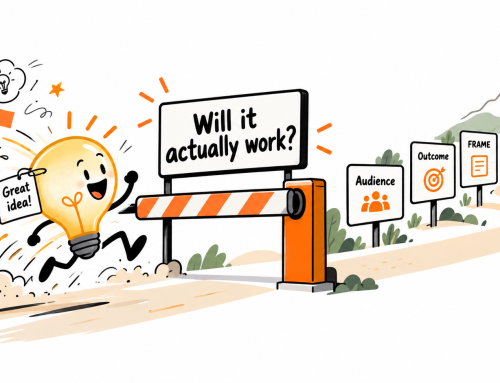
So how do you disrupt without damaging your brand? In my experience, even disruptors need four guiding lights.
Start with what you genuinely believe
The first is values. What do you genuinely believe? If you are a hard-core rock radio station, a certain amount of provocation probably comes with the territory. If you are an ethical, trusted or highly regulated brand, the test is different. You need to know what your truth is, because disruption works best when it comes from conviction rather than attention-seeking.
That phrase from the meeting mattered because it gave the disruption a reason to exist. “We believe.” There was something underneath the idea beyond wanting to sound bold, different or exciting. If there is no genuine belief supporting the provocation, then what looks like disruption can very quickly become little more than theatre.
Think about what your audience will actually hear
The second is audience. It is easy to become fascinated by what you want to say, but the more useful question is what your audience will actually hear. What do they believe already? What will ring true with them? What assumptions are you challenging, and what might they misunderstand? You can have the cleverest disruptive idea in the world, but if your audience hears arrogance, insensitivity or something completely different from what you intended, the idea has failed.
This is where internal excitement can become dangerous. A room full of people who understand the background, the strategy and the intention may hear something completely differently from someone encountering the message cold. Your intention matters, but interpretation matters just as much.
Know what change you are actually trying to create
The third is outcome. Disruption needs a destination. Are you trying to start a debate, change behaviour, get an issue discussed differently, challenge an outdated assumption or move an industry forward? If you cannot clearly explain the change you want the communication to help create, “disruptive” is probably just another word for noisy.
This also forces you to distinguish between attention and progress. Plenty of ideas can create headlines or reaction, but that does not necessarily mean they move you any closer to the thing you actually wanted to achieve. The provocation has to serve the purpose, not become the purpose. And yes, make sure it is legal. That helps.
Work out what happens if it goes wrong
The fourth is risk, and this is the part people sometimes skip when the excitement takes over. Imagine Jane goes to the press because she lost the car competition, saw hers crushed and now can’t get her kids to school. Is that a foreseeable consequence? Can it be mitigated? Is it worth it? And if it happens, have you already thought about what you are going to say?
Sometimes the answer will still be yes. The attention, debate or impact may justify the risk, and clear messaging can be prepared in advance. Other times the potential fallout may damage trust, create regulatory problems or undermine the whole purpose of the campaign. In those cases, the clever idea probably isn’t worth it.
There is another uncomfortable truth here too: sometimes you can be right and still get a kicking. You may genuinely believe an industry practice, convention or accepted way of doing things needs to change, and you may even be proved right in the end. That does not mean the people invested in the old way are going to applaud politely while you challenge it. The fact that criticism is predictable does not automatically mean you should retreat from the idea, but it does mean you should be ready for it.
That is why the risk needs to be thought through before launch. What are the likely objections? Who is most likely to push back? What would you say if they did? Which criticism would you be prepared to absorb because the change matters enough, and which kind of backlash would tell you the idea has crossed a line? The important thing is that those questions are asked beforehand, not discovered when somebody is suddenly putting awkward questions to you afterwards.
Which brings me back to that meeting. I was happy with their answer because they weren’t trying to be disruptive simply because somebody had written “BE BOLD” on a strategy slide. They had a belief, they understood their audience, they had a change they wanted to create and they recognised that challenging an established conversation carried some risk. That feels very different from provocation for its own sake.
Perhaps the real distinction, then, is that “safe” and “responsible” are not the same thing. You can be responsible, evidence-led, legally sound and completely aligned with your values while still saying something that challenges the status quo. Equally, you can make your messaging so safe that nobody notices it, nobody argues with it and nobody changes anything because of it.
In a world where AI can produce competent, agreeable, middle-of-the-road content by the tonne, that may increasingly be the greater risk. So perhaps the question is not simply, “Is this message risky?” It is: “Is the risk worth taking, and do we know why we’re taking it?”