MESSAGES THAT LAND – Monday 5th October
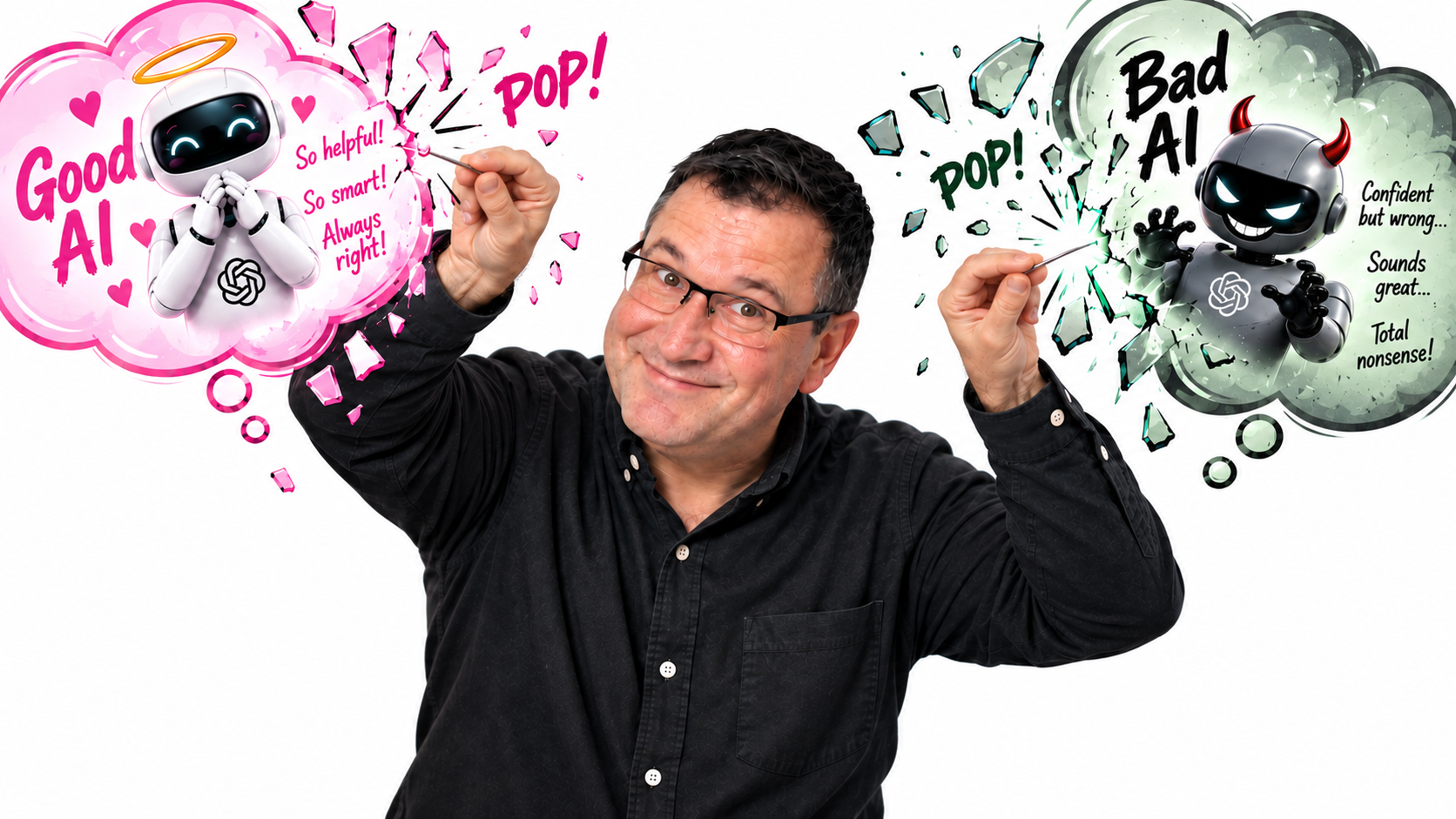
Good AI. Bad AI. Wrong question.
It’s the skill you need AFTER the AI has answered.
I was having my hair cut recently when my barber started bemoaning AI. You know the conversation. It’s going to take people’s jobs, it can’t be trusted, it doesn’t really know anything and it’ll never be as good as someone who has spent years learning their craft.
A few chairs down was a young apprentice barber, so I pointed at her. She’s been trained, I said, but I bet you still keep a guiding eye over her work. Of course he does. And I suspect he’ll be doing that for considerably longer than a week, through a few questionable fades and perhaps the occasional endangered ear. Being trained doesn’t automatically make you excellent, and experience gives you something important: you know what good looks like.
But there is another side to that relationship. That young barber will almost certainly challenge some of the experience around her too. She will have different influences, different customers and perhaps newer ideas about styles and techniques. The experienced barber has plenty to teach her, but that doesn’t mean all the learning travels in one direction.
That feels increasingly like the most useful way to think about AI.
I don’t actually mind when AI gets something wrong. Sometimes it heads off in completely the wrong direction and my immediate reaction is, “No, that’s not what I meant at all.” But that can be useful, because it forces me to ask why it misunderstood me. Was the machine being ridiculous, or was my question vague? Did I use a word that means something very specific to me but could reasonably be interpreted another way? Did I bury the important bit under too much information?
Learning to prompt AI properly has made me think much harder about the language I use. More surprisingly, I think that has started to affect the way I communicate with people too. If a poorly framed question can send AI racing down the wrong road, what does a poorly framed idea do in a meeting? Am I successfully articulating what I want to get across? Am I using language that is perfectly clear inside my head but far less clear to the person sitting opposite me?
I saw the other side of the barber analogy recently. I had a consultation with a former television presenter and came away feeling it had been a really productive meeting. I had plenty of ideas about what I had heard and where I thought the opportunities were.
Afterwards, I reviewed the conversation using a paid AI service I was comfortable using for confidential work and asked it to challenge my interpretation.
It did.
It picked up places where my own experience and assumptions appeared to be influencing the way I was reading parts of the conversation. I didn’t blindly accept its conclusions, but in a couple of places it made me reconsider what I thought I had heard. My reporting back was better because of it.
That wasn’t AI replacing more than 30 years of experience. It was another perspective making those 30 years work a little harder.
And actually, we have been doing this sort of thing for years. We ask colleagues to sense-check our thinking, challenge an assumption or simply give us another perspective before something goes out into the world. AI just makes that second pair of eyes available much more quickly.
That feels particularly relevant to me now, working among entrepreneurs, freelancers and growing businesses at PLATF9RM in Brighton. Small businesses rarely have an editor, researcher, strategist, communications adviser and devil’s advocate sitting beside them whenever an important decision needs making. For a relatively small monthly cost, AI can provide some of those additional perspectives in seconds.
So what does all this mean when we are being creative, or trying to land an important message with an audience?
“AI slop,” I hear you cry.
We all recognise it. Somebody types a prompt, presses return and pushes out whatever the machine churns back. Personally, I’m not sure I’d call that AI slop. I’d call it lazy. The problem isn’t that AI was involved. The problem is that nobody appears to have applied much judgement, taste or experience to what came out.
But I see the opposite extreme too. I’ve had plenty of conversations with executives and creatives who want to avoid AI at all costs, often because they are worried that using it somehow devalues their expertise or creativity. And sometimes the practical result is even worse: nothing gets made. The idea gets discussed, protected, refined and worried about until perfect becomes the enemy of good. Sometimes they never start in the first place.
Both are failures of critical thinking. One gives the machine too much authority. The other gives our own assumptions and biases too much authority.
And those biases can do considerably more damage to a business than a piece of imperfect copy that somebody glances over and moves on from.
The useful middle ground is much less dramatic. Use the tool. Let it challenge you. Challenge it back. Learn from where it gets things wrong and from where you get things wrong. Take advantage of its speed, but bring your own experience, curiosity and standards to what comes out.
Because perhaps the most important AI skill isn’t knowing how to get an answer from it. It’s having the critical thinking to judge the answer when it comes back.
In other words, knowing what good looks like.
P.S. Yes, the preview image is AI. ChatGPT, actually. It took 27 attempts, one threat to defect to Claude (I genuinely did this), and a bit of old-fashioned Photoshop to get it where I wanted it. Which rather proves the point.